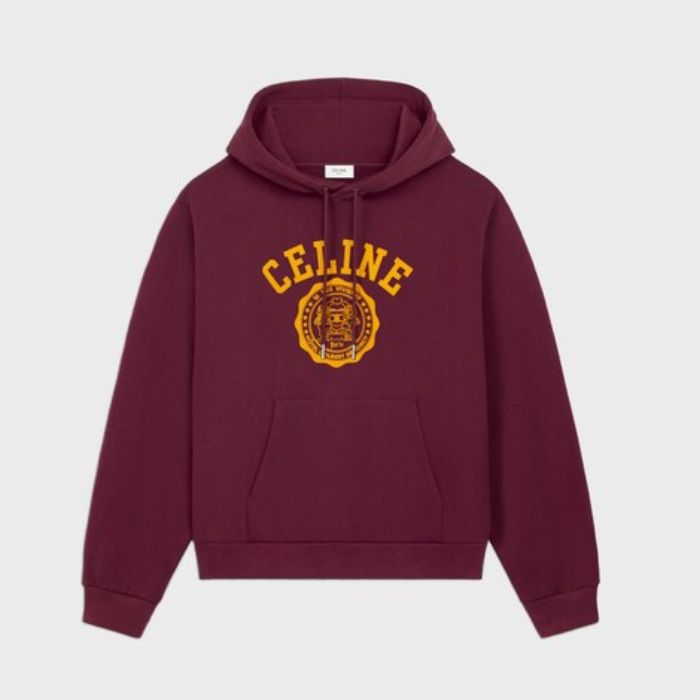
The Celine Hoodie A Haute Couture Rebellion in French Terry
In the meticulously ordered universe of haute couture, where heritage is sacrosanct and elegance is traditionally defined by structure and ceremony, a quiet revolution has been taking shape—one stitched in French terry and crowned with a drawstring. At the epicenter of this shift is the Celine hoodie, a garment that has become far more than a simple piece of casualwear. Under the exacting and transformative vision of Creative Director Hedi Slimane, this humble staple has been elevated into a potent cultural artifact, a symbol of a new luxury ethos that seamlessly blends the rebellious spirit of subculture with the impeccable craftsmanship of Parisian ateliers. To understand the Celine hoodie is to decode a complex narrative about power, identity, and the deliberate deconstruction of fashion’s traditional hierarchies. It represents a paradigm where the relaxed, anonymous silhouette of the street is meticulously refined to speak a language of insouciant privilege and razor-sharp aesthetic conviction.
The Slimane Reformation: Imposing a Singular Vision
The ascension of the hoodie within the Celine canon is inseparable from the seismic arrival of Hedi Slimane in 2018. His appointment signaled not a gentle evolution but a deliberate and decisive rupture from the past. Where his predecessor, Phoebe Philo, championed a philosophy of intelligent, minimalist ease—a “quiet luxury” of pragmatic beauty—Slimane embarked on a mission of radical redefinition. His vision is one of disciplined romanticism, drawn from a lifelong obsession with the archetypal silhouettes of rock ‘n’ roll, punk, and the gritty elegance of youth subcultures from London’s Chelsea in the 1970s to Los Angeles’s Sunset Strip in the early 2000s. Within this tightly controlled universe, the hoodie emerged as a foundational piece, a blank slate upon which Slimane could project his ideals.
Under his direction, the hoodie undergoes a process of alchemy. It is stripped of any vestiges of mere sportswear or slouchy comfort and is recast through the lens of haute tailoring. The transformation is achieved through an almost fanatical attention to proportion, fabric, and finish. A Celine hoodie is never oversized in a haphazard way; its boxy or slightly cropped cut is geometrically precise, engineered to be layered under a sharp blazer or over a silk slip dress. The fabrics are substantive and sensual: densely woven, heavyweight cotton fleece that feels armour-like in its quality, finely knitted merino wool for a sleeker drape, or technical nylon that whispers of performance. The branding, often the iconic “Celine Paris“ in stark, Helvetica-inspired typography or a more subtle tonal embroidery, is applied not as a loud logo but as a crest of belonging. Slimane’s genius lies in his ability to infuse the garment with a sense of history and authenticity it never originally possessed—each piece feels like a relic from a legendary, albeit fictional, band’s world tour, discovered in a vintage store and resurrected with flawless construction. This is not clothing designed for relaxation; it is clothing designed for the performance of a specific, coolly detached identity.
The Uniform of the Chosen: Status, Subculture, and Silent Codes
Within the ecosystem Slimane has built, the Celine hoodie functions as a keystone of a prescribed uniform, a uniform that has become one of the most influential and copied in contemporary fashion. It is part of a rigidly curated uniform of skinny black denim, perfectly battered leather jackets, crisp white shirts, and sleek ankle boots. This head-to-toe uniformity is key to its power. It does not promote individualistic mix-and-match creativity; instead, it offers the allure of instant, total immersion into a specific lifestyle fantasy—one of artistic rebellion, nocturnal energy, and a distinctly Parisian kind of bohemian chic.
This transforms the hoodie into a sophisticated and nuanced status symbol. In an era where overt logos can signify nouveau riche anxiety, the Celine hoodie often communicates its value through subliminal cues: the exact drape of the fabric across the shoulders, the weighty pull of the metal aglets on the drawstring, the stark contrast of its luxurious fleece against raw denim. It operates on a currency of recognition, legible only to those initiated into Slimane’s world. To wear it is to signal a confluence of cultural and economic capital—an understanding of the references (from the Velvet Underground to Kids), an appreciation for disciplined design, and the means to acquire its refined version of rebellion. This is perhaps Slimane’s most compelling contradiction: he sells a fantasy of anarchic, youthful freedom through garments of extreme control and expense. The hoodie becomes the central piece in a wardrobe built for those who wish to appear as if they are outside the system, while being attired in its most exclusive products. It is a badge of membership in an elite tribe defined by taste, a taste that values the patina of the underground over the gloss of the mainstream.
Cultural Contradictions: Craftsmanship, Critique, and Enduring Influence
The Celine hoodie’s position at the pinnacle of luxury casualwear inevitably invites intense scrutiny and critique, much of which is central to its controversial allure. Its four-figure price tag is defended by the house through an argument of transcendent craftsmanship—the precision of its single-needle stitching, the longevity of its dyes, the carefully calibrated density of its loopback cotton. It is presented not as a seasonal trend but as a permanent object, an investment in a lasting aesthetic.
Yet, this very framing fuels its detractors. Critics argue that Slimane’s Celine represents the apex of subculture’s commodification, systematically draining the genuine rebellion from punk, grunge, and skate styles and repackaging them as sterile, consumable assets for the global jet set. The “youth” he mythologizes is an aestheticized fiction, one accessible only to those with significant wealth, thereby raising poignant questions about authenticity and cultural appropriation in fashion. Furthermore, his relentless, season-after-season dedication to the same core silhouette—with only minor variations in fabric or logo placement—is interpreted by some as a lack of creative progression, a stark monologue in an industry built on dialogue.
Conclusion: The Defining Silhouette of a New Era
The Celine hoodie is ultimately a garment of profound contradiction and even greater influence. It is a humble sweatshirt rendered in the image of haute couture; a symbol of rebellion available by appointment only; a piece of casualwear that demands to be taken with the utmost seriousness. It stands as the definitive emblem of Hedi Slimane’s reformation of Celine, a perfect distillation of his quest to capture the elusive cool of youth and frame it within the pristine white walls of a Parisian maison.
It represents more than a fashion item; it is a tool for the performance of a contemporary identity that values discernment over display, and studied nonchalance over obvious opulence. In its precise seams and weighted hem, we find the story of modern luxury’s great pivot—the moment the industry looked beyond its own hallowed traditions, embraced the uniform of the street, and proceeded to rebuild it, stitch by perfect stitch, in its own impeccable image. The Celine hoodie is not about comfort in the physical sense; it is about the comfort of belonging to a singular, powerfully articulated vision of what it means to be modern, elegant, and undeniably cool. As long as that aspiration persists, its iconic silhouette will remain a cornerstone in the architecture of contemporary style.
Vised Site: skyfoxrz


Freight Forwarding Services in Canada: How Progressive Cargo Simplifies Global Logistics
Freight forwarding plays a crucial role in today’s interconnected global economy. Business…