
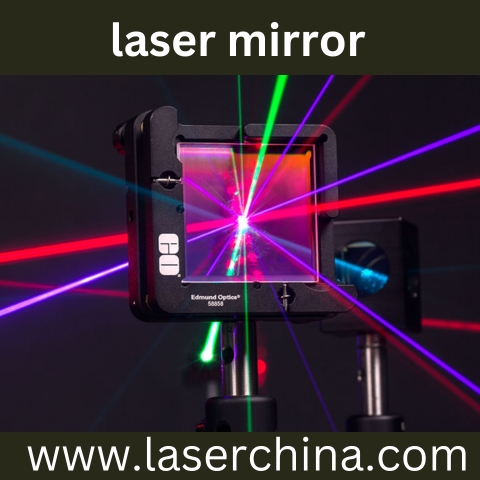
A laser mirror is a critical optical component used to control, direct, reflect, and stabilize laser beams in a wide range of industrial, scientific, medical, and commercial applications. Designed to handle highly concentrated light energy, a laser mirror plays a central role in maintaining beam accuracy, consistency, and alignment across complex laser systems. Its presence is essential wherever precision light manipulation is required, from advanced manufacturing environments to laboratory research and medical equipment.
Unlike standard reflective surfaces, a laser mirror is engineered specifically for laser wavelengths and power levels. It is manufactured using specialized substrates and coatings that ensure controlled reflection while maintaining surface integrity under intense light exposure. This makes the laser mirror a foundational element in laser-based operations where even minor deviations can affect performance, quality, and reliability.
Role of Laser Mirror in Modern Laser Systems
In modern laser systems, the laser mirror functions as a directional and control element. It ensures that the laser beam follows a predefined optical path with minimal distortion. Whether used in cutting machines, engraving units, marking systems, or scientific instruments, the laser mirror contributes to beam steering and spatial accuracy.
Laser mirrors are frequently used in beam delivery systems where lasers must travel through multiple optical elements before reaching the target. By reflecting the beam at precise angles, a laser mirror allows compact system design and flexible layout configurations. This makes it possible to integrate laser technology into confined spaces without compromising output consistency.
In industrial environments, the laser mirror supports continuous operation by maintaining optical alignment even during extended usage cycles. This reliability makes it indispensable in automated production lines and high-duty-cycle systems.
Materials and Construction of a Laser Mirror
The construction of a laser mirror is a specialized process that balances optical precision with durability. Common substrate materials include optical-grade glass, fused silica, silicon, and copper. Each material is selected based on the laser’s wavelength, power density, and environmental conditions.
The reflective surface of a laser mirror is coated with thin-film layers engineered for specific wavelengths. These coatings are applied using advanced deposition techniques to ensure uniformity and reflectivity. The coating design allows the mirror to reflect targeted laser light efficiently while managing thermal effects caused by high-energy beams.
Surface flatness and polish quality are critical factors in a laser mirror’s performance. High-precision polishing ensures minimal scattering and maintains beam quality throughout the reflection process. This level of craftsmanship is essential in applications where beam shape and focus directly impact results.
Laser Mirror Applications Across Industries
The versatility of the laser mirror allows it to be used in multiple industries. In manufacturing, laser mirrors are integral to laser cutting, welding, drilling, and marking systems. They help direct the laser beam accurately onto metals, plastics, ceramics, and composite materials.
In medical technology, laser mirrors are used in surgical lasers, diagnostic equipment, and therapeutic devices. Their precision supports controlled energy delivery, which is crucial in sensitive procedures. Research laboratories rely on laser mirrors for experiments involving spectroscopy, interferometry, and optical measurements.
The electronics industry uses laser mirrors in semiconductor fabrication and micro-machining processes. Here, the ability to precisely guide laser beams contributes to consistent production outcomes. Even in entertainment and display technology, laser mirrors are used in projection systems and light shows to create controlled visual effects.
Optical Performance and Beam Control
A laser mirror directly influences beam behavior within an optical system. By reflecting light at specific angles, it allows engineers to manage beam direction without altering laser source alignment. This is especially important in multi-axis systems where lasers must move dynamically while maintaining consistent output.
Beam stability is another key function supported by a laser mirror. Through precise mounting and alignment, mirrors help reduce vibration-related deviations. This stability ensures predictable beam positioning, which is essential for repeatable results in industrial and scientific tasks.
Laser mirrors also support wavelength-specific performance. By tailoring coatings to match the laser source, systems achieve efficient reflection while minimizing unwanted absorption. This controlled interaction between light and surface enhances overall system reliability.
Integration of Laser Mirror in System Design
Designing a laser system requires careful consideration of how each optical component interacts. A laser mirror is often positioned early in the optical path to define beam direction or later to redirect the beam toward the work area. Engineers select mirror size, shape, and coating based on spatial constraints and performance requirements.
Mounting mechanisms play an important role in laser mirror integration. Precision mounts allow fine angular adjustments, ensuring accurate alignment during setup and maintenance. Once installed, a properly aligned laser mirror contributes to long-term system stability.
Thermal management is another design consideration. In high-power applications, laser mirrors may be paired with cooling structures to maintain consistent optical behavior. This approach supports continuous operation without compromising reflective quality.
Quality Standards and Manufacturing Precision
The production of a laser mirror follows strict quality standards to meet the demands of advanced laser systems. Optical testing ensures that surface accuracy and reflectivity meet specified tolerances. Interferometric measurements are commonly used to verify flatness and coating performance.
Manufacturers focus on repeatability and consistency, especially for applications requiring multiple mirrors within a single system. Uniform performance across components allows predictable optical behavior and simplifies system calibration.
Packaging and handling are also important aspects of laser mirror quality. Protective measures prevent contamination or surface damage before installation. Cleanroom manufacturing environments are often used to maintain optical purity throughout the production process.
Market Demand and Industry Growth
The demand for laser mirror technology continues to grow alongside the expansion of laser-based applications. As industries adopt automation and precision manufacturing, the need for reliable optical components increases. Laser mirrors support this growth by enabling accurate beam control across diverse use cases.
Emerging technologies, such as additive manufacturing and advanced medical treatments, further drive interest in high-quality laser mirrors. Their role in enabling precise energy delivery aligns with the evolving requirements of modern systems.
Customization options also contribute to market growth. Laser mirrors can be tailored to specific wavelengths, sizes, and environmental conditions, making them adaptable to a wide range of applications.
Maintenance and Operational Considerations
Maintaining a laser mirror involves careful handling and periodic inspection. Dust, debris, or surface contamination can affect reflectivity and beam quality. Proper cleaning methods and controlled environments help preserve optical performance.
Alignment checks are part of routine system maintenance. Over time, mechanical shifts may require minor adjustments to ensure the laser mirror continues to reflect the beam accurately. These practices support consistent system output and reduce downtime.
Storage conditions also influence mirror longevity. When not in use, laser mirrors are typically stored in protective cases to prevent exposure to moisture or contaminants.
Future Outlook for Laser Mirror Technology
As laser systems become more advanced, the role of the laser mirror continues to evolve. Innovations in coating technology and substrate materials support higher power handling and wavelength flexibility. These developments align with the growing complexity of laser applications across industries.
Miniaturization trends also influence laser mirror design. Compact systems require smaller optical components without sacrificing performance. Precision manufacturing techniques enable the production of laser mirrors that meet these demands.
The ongoing integration of lasers into new fields ensures that the laser mirror remains a central element in optical engineering. Its ability to control and direct light with precision makes it an enduring component of modern technology.
Freight Forwarding Services in Canada: How Progressive Cargo Simplifies Global Logistics
Freight forwarding plays a crucial role in today’s interconnected global economy. Business…