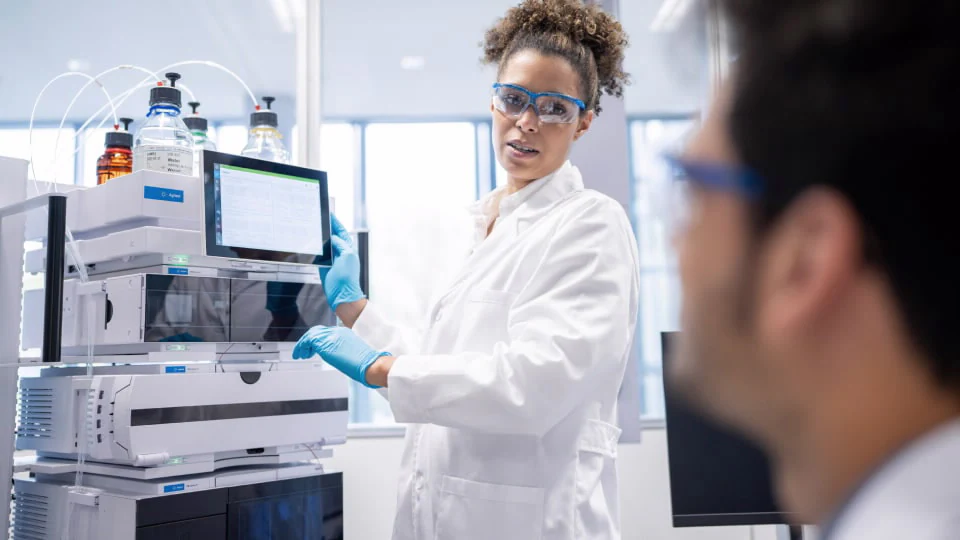
High-Performance Liquid Chromatography (HPLC) serves as a cornerstone analytical technique in pharmaceutical bioanalysis, enabling precise separation, identification, and quantification of drug components. HPLC Testing Services deliver GLP-compliant data essential for purity assessment, potency verification, and stability evaluation, in accordance with FDA and ICH standards. Evolving demands for higher resolution, faster analysis, and greater sensitivity have driven advancements such as Ultra-High-Performance Liquid Chromatography (UHPLC) and Liquid Chromatography-Mass Spectrometry (LC-MS). Each method offers distinct capabilities suited to specific bioanalytical challenges in drug development.
Core Principles of HPLC Technology
HPLC separates compounds based on their differential interactions with a stationary phase packed in a column and a liquid mobile phase pumped at high pressure. The pump maintains consistent flow rates, usually 0.5–2.0 mL/min, while the injector delivers precise sample volumes. Separation occurs as analytes partition between phases, with retention times determined by polarity, size, and chemical properties. Detectors such as UV-Vis or fluorescence quantify eluting peaks, generating chromatograms processed by integrated software.
This method excels in routine quality control, providing reproducible results for assay validation. In a GLP-compliant environment, HPLC ensures data integrity through calibrated instrumentation and standardized protocols. Its reliability supports pharmacokinetic studies and impurity profiling, where trace-level detection aligns with regulatory thresholds.
Advancements in UHPLC Systems
UHPLC builds on HPLC principles but employs columns packed with sub-2 μm particles, enabling operation at pressures up to 15,000 psi compared to HPLC’s 6,000 psi limit. Smaller particles yield sharper peaks and higher plate counts, achieving resolutions exceeding 100,000 theoretical plates per meter. Flow rates reach 0.8 mL/min, reducing analysis times from hours to minutes.
HPLC Testing Services increasingly incorporate UHPLC for high-throughput applications, such as stability-indicating assays. The enhanced efficiency minimizes solvent consumption and supports faster method development. However, UHPLC demands specialized instrumentation resistant to high pressures and robust fittings to prevent leaks. Validation under GLP conditions verifies system suitability, ensuring precision across gradients and mobile phase compositions.
In pharmacodynamic evaluations, UHPLC accelerates potency determinations by resolving closely eluting impurities within 5–10 minutes. Its superior peak capacity proves invaluable for complex formulations containing multiple APIs and excipients.
Integration of LC-MS for Enhanced Detection
LC-MS couples liquid chromatography with mass spectrometry, combining chromatographic separation with mass-to-charge ratio analysis. Post-column, analytes enter the mass spectrometer via electrospray ionization (ESI), where they fragment into characteristic ions. Tandem MS (MS/MS) modes, such as multiple reaction monitoring (MRM), provide unparalleled selectivity by monitoring precursor-to-product ion transitions.
This hybrid approach surpasses standalone HPLC in specificity, identifying unknowns through accurate mass measurements and structural elucidation. LC-MS detects analytes at femtogram levels, critical for metabolite identification and trace impurity TK Analysis. GLP-compliant workflows incorporate internal standards and quality controls to maintain accuracy within 15% bias and 20% coefficient of variation.
HPLC Testing Services, leveraging LC-MS, excel in bioanalytical method validation, supporting pharmacokinetic parameters like AUC and Cmax calculations. The technique handles matrix effects through sample cleanup via solid-phase extraction, ensuring robust quantification in plasma or tissue homogenates.
Comparative Performance Across Techniques
| Parameter | HPLC | UHPLC | LC-MS |
| Pressure (psi) | ≤6,000 | ≤15,000 | Variable (HPLC/UHPLC front-end) |
| Particle Size (μm) | 3–5 | <2 | <2 (UHPLC) |
| Analysis Time | 10–60 min | 2–10 min | 5–20 min |
| Resolution | High (N=10,000–30,000/m) | Very High (N>100,000/m) | Highest (MS selectivity) |
| Sensitivity | pg–ng | fg–pg | fg–ag |
| Cost | Moderate | High (instrumentation) | Highest (MS maintenance) |
HPLC remains cost-effective for standard potency and purity assays, while UHPLC prioritizes speed in method screening. LC-MS dominates confirmatory analysis, providing structural confirmation unavailable with optical detection.
Must Read: ddPCR Assay: A Tool for Detecting Rare Genetic Variants
Applications in Regulated Bioanalysis
In drug development, these techniques address distinct needs. HPLC supports raw material release testing and dissolution profiles, ensuring batch uniformity. UHPLC streamlines in-process controls, analyzing multiple samples hourly to maintain production timelines. LC-MS characterizes degradation pathways and supports toxicokinetic studies by identifying Phase I and II metabolites.
HPLC Testing Services integrates all three for comprehensive workflows. Initial screening employs UHPLC for rapid profiling, followed by LC-MS confirmation of unknowns. Such tiered approaches comply with ICH Q3A/B guidelines, quantifying impurities below 0.1% thresholds.
Regulatory Compliance and Validation
GLP principles govern method development across platforms. Validation parameters, accuracy, precision, linearity, specificity, and robustness must demonstrate fitness for purpose. HPLC methods require baseline resolution (Rs > 2.0), while UHPLC methods tolerate elevated backpressures. LC-MS incorporates ion suppression tests and matrix factor calculations.
FDA-audited laboratories document instrument qualification, including pump flow accuracy (±1%) and detector linearity (R²>0.995). Transferability between HPLC labs ensures consistent performance across sites.
Challenges and Mitigation Strategies
HPLC column lifetime is limited at high pH, but hybrid silica phases mitigate this. UHPLC risks frit clogging, addressed through inline filters. LC-MS is challenged by ion source contamination, managed through divert valves and scheduled maintenance.
Selection hinges on analyte properties: polar metabolites favor LC-MS, while volatile compounds suit UHPLC with volatile gradients.
Conclusion
HPLC, UHPLC, and LC-MS represent progressive evolution in bioanalytical separation science, each optimized for pharmaceutical demands. HPLC provides foundational reliability, UHPLC accelerates throughput, and LC-MS delivers definitive identification. HPLC Testing Services employing these techniques ensure GLP-compliant data supporting regulatory submissions. Strategic integration enhances efficiency, precision, and confidence in drug quality assurance, advancing the development of safer therapeutics through rigorous analytical controls.
Freight Forwarding Services in Canada: How Progressive Cargo Simplifies Global Logistics
Freight forwarding plays a crucial role in today’s interconnected global economy. Business…