
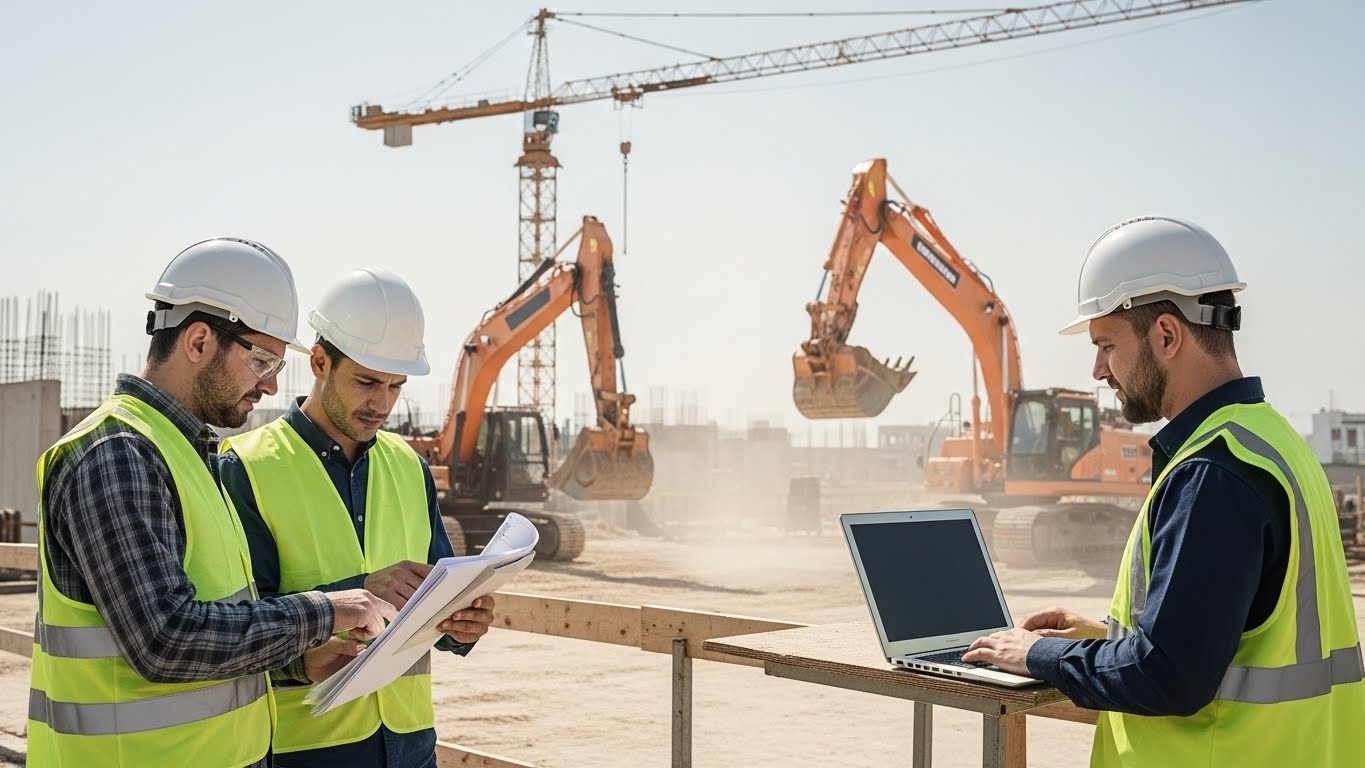
AI will revolutionize construction to make it safer, accelerate construction schedules, reduce costs, and increase precision, although it will also interfere with conventional jobs and will have to be trained to meet the requirements.
And now, it is time to dissect the way AI is redefining one of the oldest industries in the world and what it actually implies about the future of the builders, architects, and project managers.
The Truth Behind The Use Of Ai In Construction
And the point is that nowadays construction is not only about bricks, beams, and plans. It’s about data. Artificial Intelligence is intervening to process that information quicker than any human group ever could. AI is transforming the project planning and execution process by ensuring materials are not out of stock, accidents are avoided on the site, and so forth.
To consider an example, we can take a 100 story skyscraper project. Conventionally, it may take years of planning and coordination. The same plan is possible to be generated, modified, and optimized in just a fraction of the time using AI-based modeling.
It is not science fiction but it is going on in businesses all over the world.
The Short-Term AI in the Construction Industry
1. Smarter Planning and Design
BIM tools that use AI are now in the position to identify clashes and errors in the design earlier than they even make it to the construction site. This will result in less time wastage and material wastage.
The predictive designing software now allows the architects and the engineers to suggest the structure solutions and even predict the effect of weather to the materials in terms of load bearing efficiency.
In more straightforward words: AI assists you to build it once.
2. Reduced Project Estimation and Budgeting
Construction budgeting has never been easy. Cost overruns are a nightmare because of too many variables, such as labor and materials and unforeseen delays. However, now AI estimation systems are capable of handling historical information of hundreds of similar projects and providing almost accurate predictions.
Several of the estimation companies in USA already have AI automating takeoffs and project cost modelling allowing firms to avoid spending money before the work has even started.
This will not only save time, but also customer confidence, since there is nothing like a surprise when it comes to budget.
3. Enhanced Safety on Site
This is what the majority of people do not know: construction has been rated as one of the most hazardous jobs in the world. Machine learning-driven AI surveillance systems have become able to recognize unsafe behaviors (such as missing helmets or unsafe scaffolding) to prevent accidents.
Other companies go so far as to employ wearable AI gadgets that monitor employee exhaustion and stress rates to enable bosses to step in before it is too late. AI is not only protecting profits, but also lives.
4. Maintenance and Equipment Monitoring Prediction
Admittedly, the breakdown of machines on the spot may put the whole process to a halt. In heavy machinery, AI systems are now responsible due to sensors detecting the essential first signs of wear and tear.
AI will save time and expensive downtime as opposed to waiting for the failure of a bulldozer in the middle of its work.
The result? A seamless, more foreseeable work process that is a lot less stressful to all parties.
The Underestimated Problems of AI Adoption
Now it is no longer sunshine and steel beams. Although AI is accompanied by unbelievable benefits, there exist real-life issues.
1. Displacement of Job and Skill Gaps
It is a fact that automation will eliminate some of the repetitive jobs. Their functions might change or even be eliminated as new positions emerge and are worked by manual estimators, data entry clerks and a few project coordinators.
Still, there is the good news here; new employment is being created at an equal pace. The robot technicians, data engineers, drones operators, and AI specialists are in demand. People are not losing their jobs in the construction industry, it is just that it is redefining careers.
2. Risks of Data Privacy and Cybersecurity
The security of data is now a great concern with all the interconnected systems and cloud based platforms. One cyberattack would cripple the whole construction networks.
To reduce this, companies are putting up great investments on cybersecurity measures, where sensitive blueprints, financial information, and sensor observations are secured.
3. The Cost of Implementation
To implement AI technology is not cheap, particularly to small companies. The software, hardware and training expenses may accumulate fast.
The scholars are in agreement: the efficiency savings and the decreased error rates are frequently much greater than the initial investment in the long run. Imagine paying more to get smarter, faster and safer operations in the future.
Real Life Applications Of Ai In Practice
We can divide it into a couple of success stories:
- A large international contractor, Skanska, employs an AI algorithm to track compliance in safety and project schedule, and the accidents have decreased approximately 20 percent.
- The robot dog, Spot, by Boston Dynamics is being utilized to scan and map job sites on its own.
- Autodesk Construction Cloud also uses AI to forecast the subcontractors that may lead to project delays according to their past behavior.
These examples can demonstrate that AI is not mere theory but the future of the construction that already begins to open its eyes in front of us.
Ai In Future Construction: It Is Just Collaborative, Not Replacement
This simply implies that AI will not replace construction, it will collaborate with humans. The constructors of tomorrow will put on the smart helmets, refer to the AI-based planning boards, and track the project with the help of voice.
Indeed, according to industry analysts, in 2030, more than 70 percent of construction firms will incorporate some sort of an AI-powered system.
Instead of being afraid of the change, it is time to learn it, get used to it and use it to create better, safer and more sustainable structures.
Conclusion
In that way, what will AI do to construction?
In a word, it will make it a revolution. AI will have an impact on all sectors of the industry, encompassing safety and efficiency, to design precision and cost management. However, it is those who study, develop and join the technology instead of fighting it that will be successful.
AI is not disabling builders, it is making them cleverer, quicker and more secure than they have ever been. It is not man vs. machine, but man and machine, constructing collectively in the future.
FAQs
Will Artificial Intelligence Eliminate Human Labor In Building?
No. AI will not only complete the repetitive and data-intensive jobs but will not substitute skilled labor. Human beings will still be in demand in making decisions, creativity and supervising fields.
When Is Ai Going To Be Mainstream Where Construction Is Concerned?
Analysts also forecast that by 2025-30, the use of AI will be a norm among large construction companies and will be used in the estimation of projects, designing models and safety checks.
How Can Small Contractors Benefit From Ai?
Even small companies can use affordable AI tools for estimating, scheduling, and safety compliance. Many cloud-based platforms offer subscription models tailored for smaller budgets.

Freight Forwarding Services in Canada: How Progressive Cargo Simplifies Global Logistics
Freight forwarding plays a crucial role in today’s interconnected global economy. Business…